Concussion in Youth Soccer: Warning Signs and the 6-Step Return to Play
In short: most concussions in soccer happen without a knockout, and players almost always say they are fine. Check for red flags first and call an ambulance if you see one. If anything else seems wrong, take the player off: no return the same day. Recovery then follows a six-step plan, with at least 24 hours per step, so it takes at least a week, and school comes before full competition. Written by an emergency physician who is also a neurosurgeon, following the 2022 Amsterdam international consensus on concussion in sport.
Published 6 October 2026 · By Dr.Kazu Soccer, emergency physician and neurosurgeon · 日本語版はこちら (Japanese version)
Why this matters on match day
Soccer is not usually thought of as a collision sport. Yet in every match there are moments when a player's head is suddenly jolted: two players going up for the same header, an elbow in an aerial duel, a goalkeeper colliding with a striker, or a fall onto the back of the head. In Japan's summer high-school tournaments, teams may also play on consecutive days, which leaves little time to notice symptoms that develop slowly.
As an emergency physician I see players after head knocks, and I still hear the same reasoning from the sideline: "He didn't black out, so he's fine," or "She just needs a minute." Both assumptions are wrong, and the second can be dangerous. This page sets out what to look for, what to do in the first 48 hours, and how to bring a player back safely.
1. A concussion is an injury to how the brain works, not to its structure
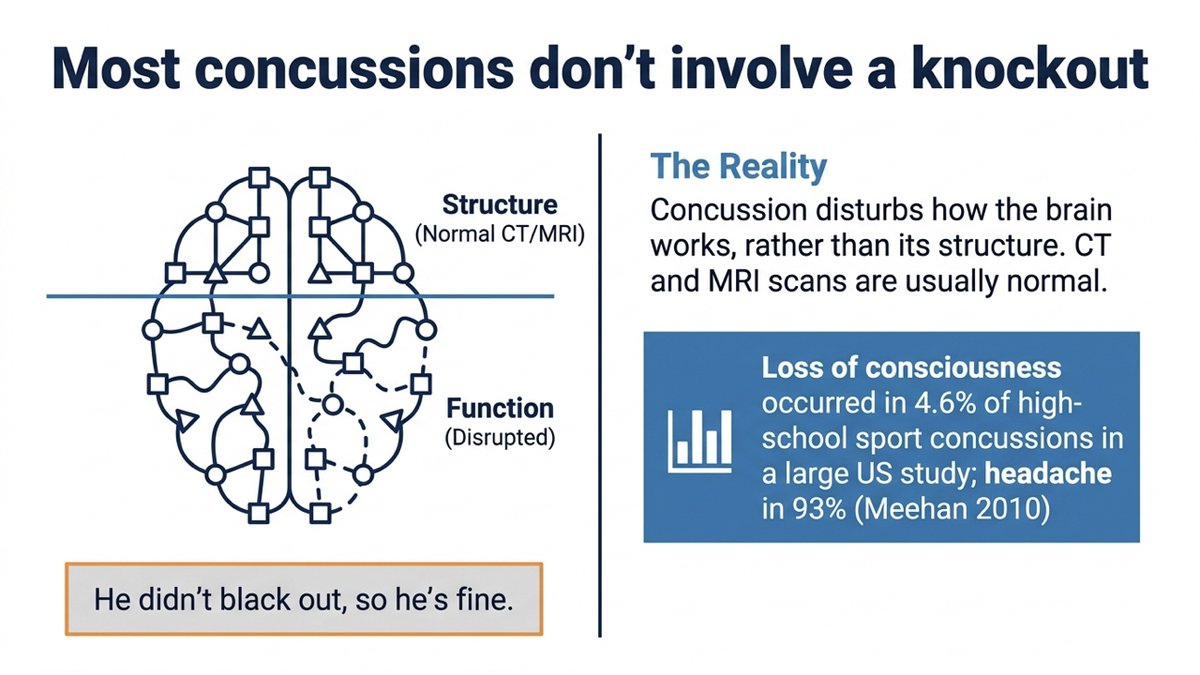
A concussion is a brain injury caused by a blow to the head, or by a blow elsewhere on the body that jolts the head. It disturbs how the brain works for a while, rather than damaging its structure, so CT and MRI scans are usually normal. A normal scan shows there is no bleeding or fracture at that time; it does not rule out a concussion.
Three facts that every coach and parent should know:
- Most concussions happen without a knockout. In a large US study of high-school athletes, only 4.6% of concussions involved loss of consciousness, while 93% involved a headache.
- Symptoms vary. They include headache, dizziness, feeling dazed or "in a fog", blurred vision, nausea, poor balance, sensitivity to light or noise, being unusually emotional or irritable, and memory gaps around the incident.
- The player is the worst judge. Adrenaline masks symptoms, and the injury itself affects judgment. A concussed player saying "I'm fine" tells you very little.
That is why the decision should never be left to the player alone.
2. On the touchline: red flags first, then signs of concussion
When a player takes a knock to the head, the first question is not "is this a concussion?" but "could this be something worse?", such as bleeding inside the skull or a neck (cervical spine) injury.
Red flags: call an ambulance
These come from the Concussion Recognition Tool 6 (CRT6), the international sideline tool for non-medical people. If any one of them is present, call emergency services (911 in the US and Canada, 999 in the UK, 112 across the EU, 000 in Australia, 119 in Japan):
- Neck pain or tenderness
- Loss of vision or double vision
- Weakness or numbness/tingling in more than one arm or leg
- Severe or increasing headache
- Seizure, fits or convulsion
- Loss of consciousness
- Increasing confusion or deteriorating conscious state (becoming less responsive or drowsy)
- Repeated vomiting
- Increasingly restless, agitated or combative
- Visible deformity of the skull
Treat every head injury as a possible neck injury: do not move the player (other than to keep the airway open) unless you are trained to do so, and wait for help.
Signs that should make you suspect a concussion
If there are no red flags, look for any of the following:
- Lying motionless, or slow to get up after the hit
- Falling without protecting themselves
- A blank or vacant look; confused, or slow to answer
- Unsteady on their feet, stumbling, poor coordination
- A facial injury after a knock to the head
- Headache, dizziness, nausea, blurred vision, feeling "not right"
- Wrong answers to simple questions. For players over 12, these questions (the "Maddocks questions" used in the SCAT6) are a quick check: "What venue are we at today?" "Which half is it now?" "Who scored last in this match?" "What team did you play last week/game?" "Did your team win the last game?" The CRT6 suggests similar questions, adapted to the sport and the player's age.
One sign is enough. Take the player off and do not let them return. The rule used around the world is short: "If in doubt, sit them out."
3. Why there is no same-day return
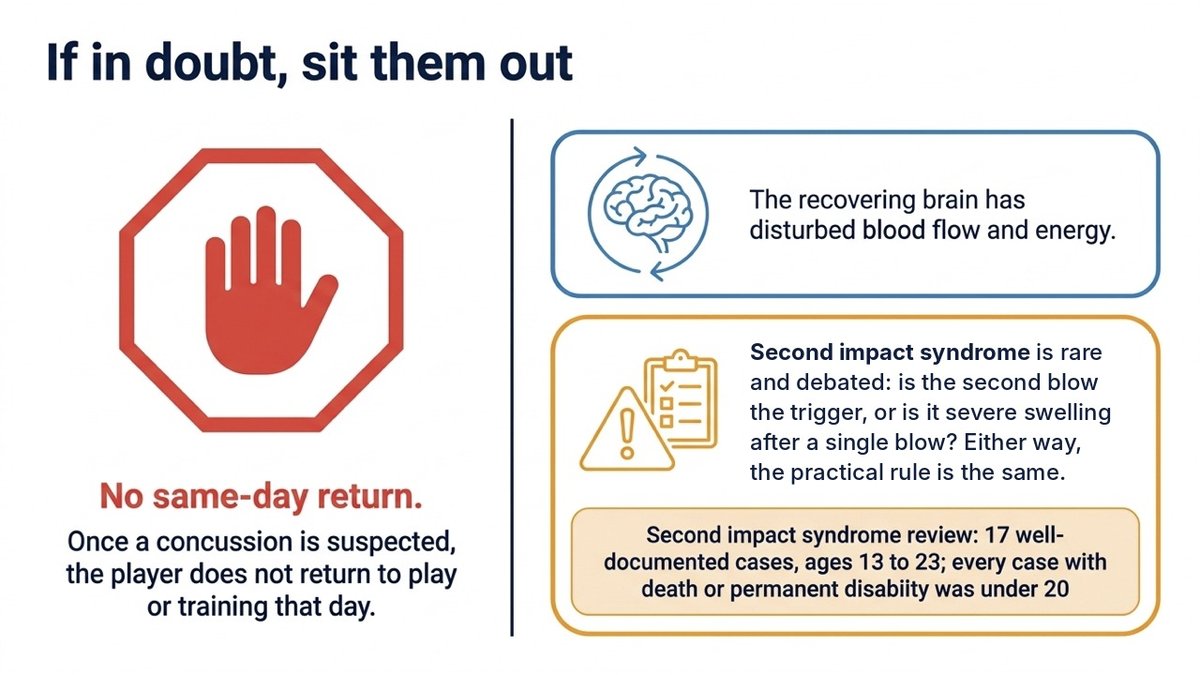
"He feels better now. Can he go back on for the second half?" This is the most common question I hear, and the answer is always the same: once a concussion is suspected, the player does not return to play or training that day. The international consensus and national football associations, including the Japan Football Association, agree on this.
There are two reasons.
The brain is still recovering. After a concussion, the brain's energy supply and blood flow are disturbed for some time after the symptoms seem to have passed. During this window, another blow, even a smaller one, can cause a more serious injury.
Second impact syndrome. Very rarely, a second blow before recovery is complete is followed by rapid, severe brain swelling. Because the skull is a closed box, the pressure inside rises quickly, and the result can be death or permanent disability. A 2016 review found 17 well-documented cases, all male, aged 13 to 23; every player with a fatal or disabling outcome was under 20. Experts still debate whether the second impact is truly the trigger, or whether this is simply severe brain swelling that can follow a single blow, which young brains seem prone to. For the touchline, the answer is the same either way: do not send a recovering brain back into play.
Some competitions now allow an extra "permanent concussion substitute" under the Laws of the Game, so a team does not lose out by taking a player off. The player who leaves cannot come back on in that match.
4. The first 48 hours
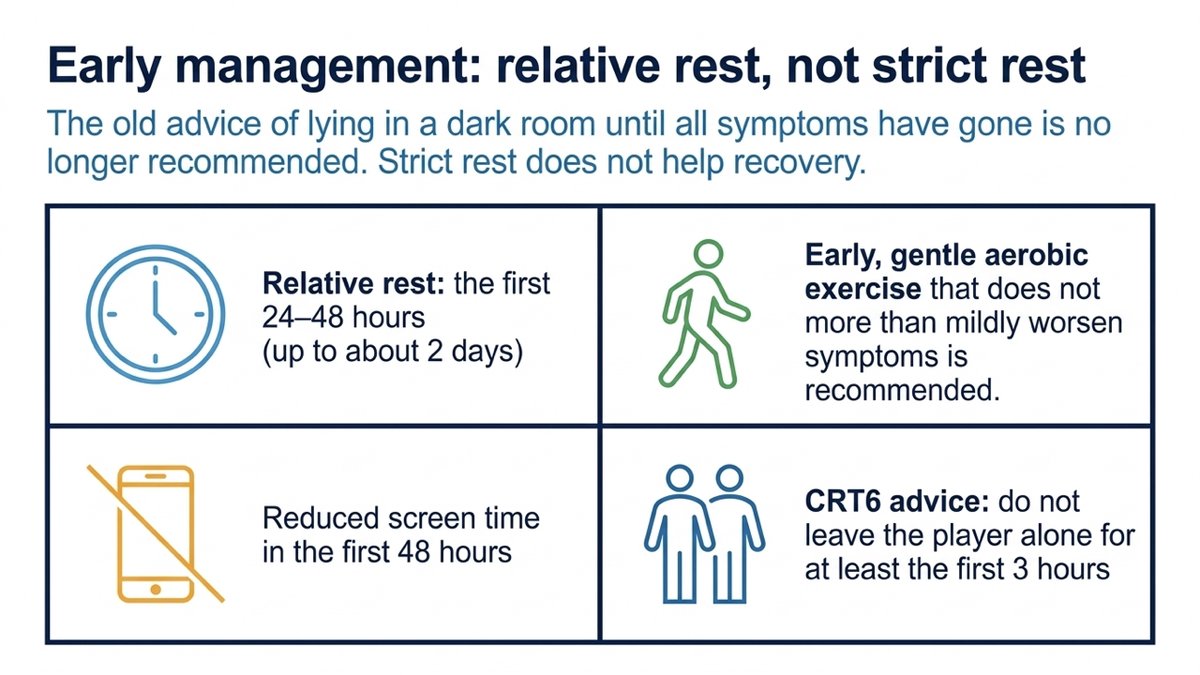
- Do not leave the player alone for at least the first 3 hours. They should not go home alone (they need to be with a responsible adult), drive, or drink alcohol until a doctor says it is safe.
- See a doctor for a proper assessment, ideally the same or the next day.
- Go to the emergency department straight away, even at night, if any red flag appears later: a headache that keeps getting worse, repeated vomiting, increasing drowsiness, confusion, a seizure, or weakness.
- Relative rest, not bed rest. For the first one to two days, normal daily activities and light walking are fine as long as they do not more than mildly worsen symptoms. Cutting down screen time in the first 48 hours helps.
- Write it down: when and how it happened and which symptoms appeared. This helps the doctor and later decisions.
Old advice to lie in a dark room until every symptom has gone is no longer recommended: strict rest does not help recovery. Current guidance is a short period of relative rest followed by early, gentle aerobic exercise.
5. Return to learn comes before full return to sport
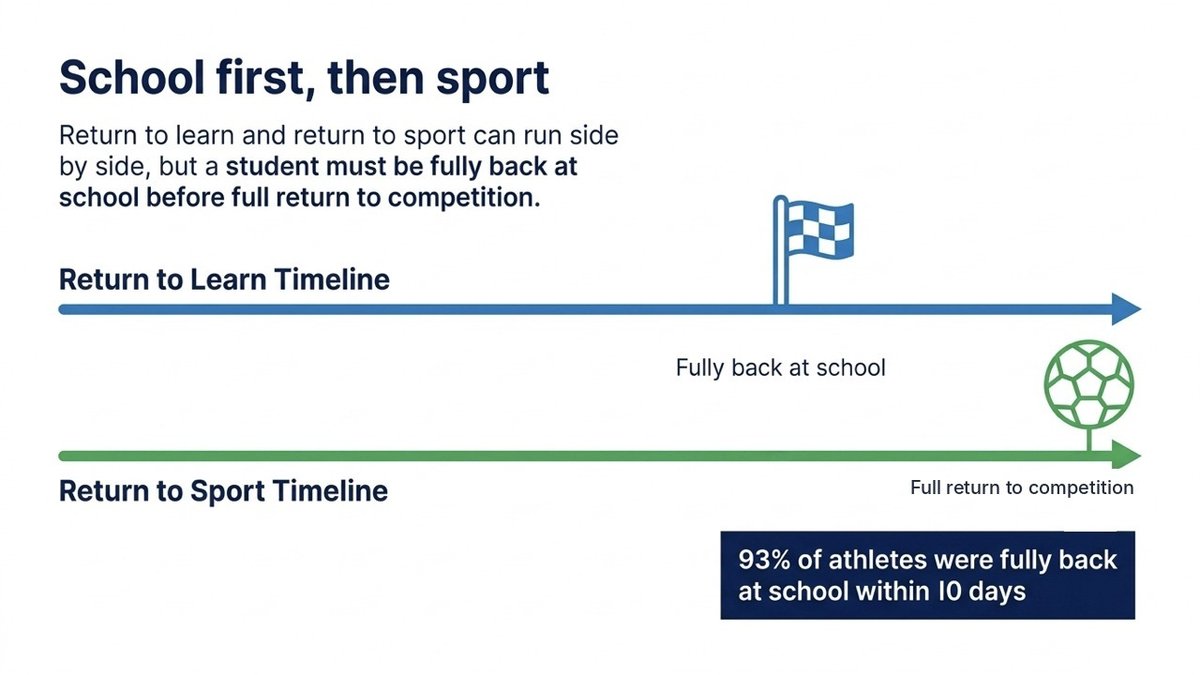
For students, getting back to school is part of recovery, not a separate issue. The return-to-learn and return-to-sport plans can run side by side, but a student should be fully back at school, without special adjustments, before returning to full competition. A brain that cannot yet cope with a full school day is not ready for contested headers.
The good news: in the Amsterdam 2022 consensus, 93% of athletes of all ages were fully back at school within 10 days without extra academic support. Parents, teachers and the coach should share what they see, so the player isn't pushed on the pitch while still struggling in class.
6. The six-step return to sport
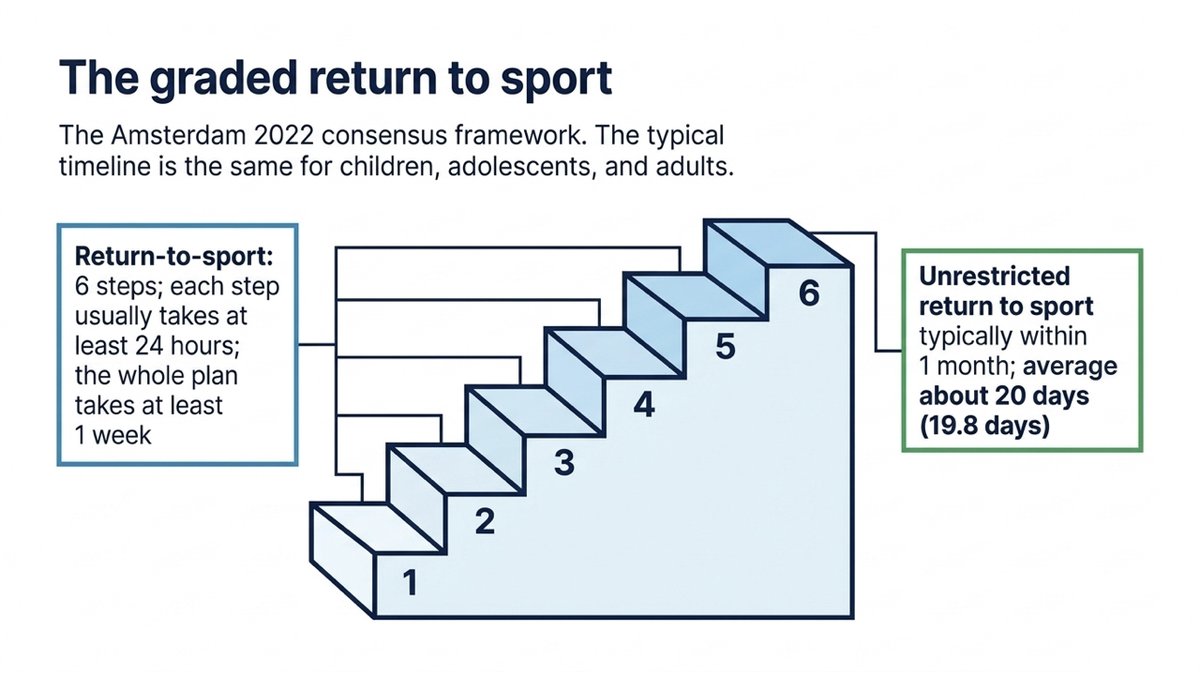
The return to soccer is decided by how far the player can progress without symptoms getting worse, not by how many days have passed. This is the graded plan from the 2022 Amsterdam consensus, adapted for soccer:
| Step | What the player does | Goal |
|---|---|---|
| 1 | Daily activities that do not more than mildly worsen symptoms: walking, light chores, school work (first 24–48 hours) | Gradual return to normal life |
| 2A | Light aerobic exercise: walking or a stationary bike, up to about 55% of maximum heart rate | Raise the heart rate |
| 2B | Moderate aerobic exercise, up to about 70% of maximum heart rate | Build tolerance to exercise |
| 3 | Individual soccer drills away from other players: running, dribbling, passing. No heading, no risk of head impact | Add movement and sport-specific skills |
| 4 | Non-contact team training drills at full intensity, including passing patterns and possession work. Only after a doctor (or other qualified health professional) has cleared the player | Normal training intensity, coordination and decision-making |
| 5 | Full-contact training, including heading and challenges | Restore confidence; let the coaching staff check skills |
| 6 | Return to matches | Full return to sport |
Step labels follow the Amsterdam 2022 return-to-sport strategy (Patricios et al., Br J Sports Med 2023). Examples are adapted for soccer.
How to use it:
- Each step usually takes at least 24 hours, so even a smooth recovery takes at least a week. Most athletes, whether children, teenagers or adults, are back to unrestricted sport within a month; in the consensus the average was about 20 days.
- Steps 1–3: a slight, brief increase in symptoms is acceptable (no more than 2 points on a 0–10 scale, settling within an hour). If symptoms rise more than that, stop for the day and try again the next day.
- Steps 4–6: these must be symptom-free. If symptoms return, go back to step 3 until exercise no longer brings them on.
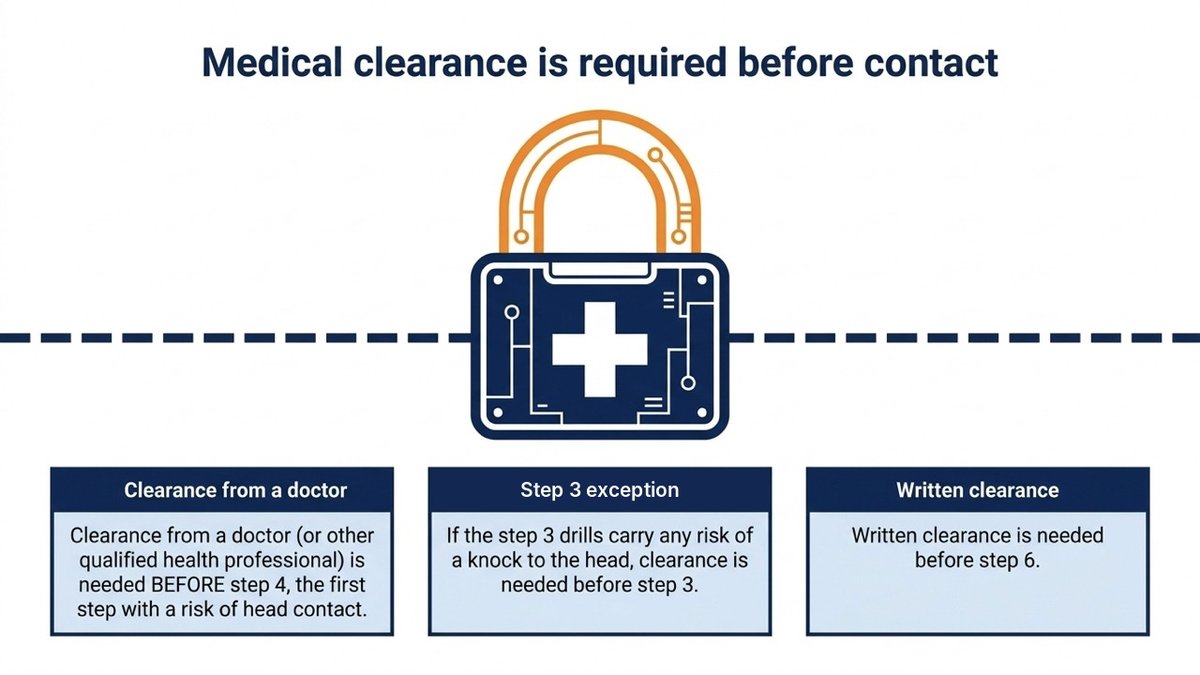
- Clearance from a doctor (or other qualified health professional) is needed before any activity with a risk of head contact: step 4 onwards, or step 3 if the drills carry any risk of a knock to the head. Written clearance is needed before the return to full competition.
- If recovery stalls, or symptoms have not clearly improved after 2–4 weeks, the player should have a fuller medical assessment and be referred for rehabilitation, which can help. Don't just wait it out.
Don't skip steps. Losing a few days is far better than going back too early.
7. What parents and coaches can do
- Make it safe to speak up. Players hide symptoms when they fear losing their place. Say clearly and often that reporting a head knock is the right thing to do, and treat it like any other injury.
- Keep a copy of the CRT6 in the kit bag. It is free, takes a few minutes, and helps volunteer coaches and parents make the same decision every time.
- Agree in advance who decides. On match day the decision to remove a player should not depend on the score or the importance of the game.
- Share information between the family, the school and the club during recovery.
8. Prevention: technique and fair play matter more than headgear
Parents often ask whether soft headgear would help. The honest answer is that there is not enough evidence: the 2022 consensus concluded that more research is needed before any recommendation on headgear can be made in sports without helmets. Headgear can prevent cuts and grazes, but a concussion happens when the brain is shaken inside the skull, which padding on the outside does little to stop.
What is more likely to help:
- Good technique in the air: watching the ball and the opponent, timing the jump, and protecting space without leading with the elbow. Many head injuries happen when a player does not see the collision coming.
- Fair play and strict refereeing: zero tolerance for elbows and reckless challenges is itself a form of prevention.
- Neck and whole-body conditioning: a strong neck may reduce how much the head is jolted on impact. The evidence is still developing, but neck strength is useful for any player and carries little risk.
Key points
- Most concussions happen without a knockout. "He didn't black out" does not mean he is fine.
- Red flags (neck pain, double vision, weak or tingling limbs, worsening headache, seizure, loss of consciousness, increasing confusion or drowsiness, repeated vomiting, agitation, skull deformity) mean calling an ambulance.
- Any sign of concussion means off the pitch and no return that day.
- Return through six steps, at least 24 hours each, with medical clearance before any risk of head contact.
- School first: full return to learning before full return to competition.
Frequently asked questions
If a player didn't lose consciousness, can it still be a concussion?
Yes. Most sport-related concussions happen without any loss of consciousness. In one large study of US high-school athletes, only 4.6% of concussions involved a knockout. Headache, dizziness, feeling dazed or "in a fog", poor balance or wrong answers to simple questions are enough to suspect a concussion and take the player off.
If the symptoms settle quickly, can the player go back on later in the same match?
No. A player with a suspected concussion should not return to play or training that day. The brain is still recovering even when the symptoms seem to have gone, and a second blow during this period can cause more serious injury. In rare cases, mostly in teenagers, it can lead to catastrophic brain swelling. If in doubt, sit them out.
How long does it take to return to soccer after a concussion?
The international return-to-sport plan has six steps, each usually lasting at least 24 hours, so the full plan takes at least a week. Most athletes are back to unrestricted sport within a month; in the Amsterdam 2022 consensus the average was about 20 days. Students should be fully back at school before they return to full competition.
Does headgear prevent concussion in soccer?
There is not enough evidence to say so. The 2022 international consensus concluded that more research is needed before any recommendation on headgear can be made in sports without helmets. Headgear can protect against cuts, but concussion is caused by the brain being shaken inside the skull. Good technique in aerial challenges and strict refereeing of elbows and dangerous play matter more.
References
- Patricios JS, Schneider KJ, Dvorak J, et al. Consensus statement on concussion in sport: the 6th International Conference on Concussion in Sport–Amsterdam, October 2022. Br J Sports Med 2023;57:695–711. doi:10.1136/bjsports-2023-106898
- Echemendia RJ, Ahmed OH, Bailey CM, et al. The Concussion Recognition Tool 6 (CRT6). Br J Sports Med 2023;57:692–694. doi:10.1136/bjsports-2023-107021
- Meehan WP 3rd, d'Hemecourt P, Comstock RD. High school concussions in the 2008–2009 academic year: mechanism, symptoms, and management. Am J Sports Med 2010;38:2405–2409. doi:10.1177/0363546510376737
- McLendon LA, Kralik SF, Grayson PA, Golomb MR. The controversial second impact syndrome: a review of the literature. Pediatr Neurol 2016;62:9–17. doi:10.1016/j.pediatrneurol.2016.03.009
- The IFAB. Laws of the Game: Additional permanent concussion substitutions protocol. theifab.com
This article gives general medical information and is not a substitute for individual medical advice. If you are unsure after a head injury, see a doctor, and call emergency services if any red flag appears. Content reflects the sources above as of October 2026. It is an English adaptation of the author's Japanese article, updated to the details of the 2022 consensus.
The illustrations on this page were created with Google NotebookLM from medical sources collected and reviewed by the author.
More from U-18 Soccer Japan
- How youth football works in Japan: high schools, J.League academies and the road to the pros.
- Inter-High 2026: Japan's summer high-school championship.
- All Japan High School Soccer Tournament: qualifying in all 47 prefectures, updated daily.